
Precision-crafted acacia, teak, and hard wood dining solutions engineered for European commercial food service and high-end retail supply chains.
Empirical performance metrics supporting Berlin’s premier wholesale importers and hospitality chains.
Berlin has established itself as Europe’s epicenter for sustainable gastronomy, eco-luxury retail, and biophilic interior architecture. From the high-end dining institutions of Mitte and Charlottenburg to the organic bistro clusters of Friedrichshain-Kreuzberg and Neukölln, commercial buyers face an evolving market mandate: eliminating single-use plastics and synthetic melamine in favor of renewable, chemically inert solid hardwood tableware.
However, importing large-scale decorative wooden salad bowls into Germany requires navigating stringent regulatory frameworks. European buyers must balance visual craftsmanship with strict adherence to the **EU Deforestation Regulation (EUDR Directive 2023/1115)**, German **LFGB (§ 30 & 31 Food Contact Safety Laws)**, and **SMETA / SEDEX** ethical workplace standards. As a premier OEM/ODM manufacturer headquartered in Thailand, Nineteen Intertrade Co., Ltd. provides Berlin importers, department store chains, and HORECA procurement managers with a vertically integrated manufacturing partner capable of delivering high-volume, custom-engineered acacia and teak salad bowls that meet every European quality benchmark.
One of the primary failure points in imported wooden kitchenware across Northern and Central Europe is structural degradation due to environmental moisture shifts. Berlin experiences seasonal relative humidity (RH) fluctuations ranging from 80% during damp autumn months down to 25%–30% in dry, radiator-heated indoor commercial environments during winter.
When raw timber with an uncalibrated Equilibrium Moisture Content (EMC) is introduced into dry German indoor spaces, rapid desorption occurs, leading to deep radial cracking, rim warping, and glue-line delamination. To eliminate these physical vulnerabilities, our manufacturing facilities utilize state-of-the-art multi-stage vacuum kiln-drying processes.
| Wood Species | Janka Hardness Rating (lbf) | Volumetric Shrinkage Coefficient (%) | LFGB Food Contact Safety Rating | Optimal Berlin Application |
|---|---|---|---|---|
| Acacia (Acacia Mangium / Arabica) | 1,750 lbf (Extremely Durable) | 3.2% (Low Movement) | Certified Non-Porous / Antimicrobial | Commercial Salad Bowls, Serving Platters, High-Traffic Bistros |
| Plantation Teak (Tectona Grandis) | 1,070 lbf (Natural Oil Rich) | 2.6% (Ultra-Stable) | Naturally Water-Resistant | Luxury Hospitality, Fine Dining, Outdoor Catering |
| Rubberwood (Hevea Brasiliensis) | 960 lbf (Medium Hardness) | 4.8% (Moderate) | Food Safe Sealed Finish | Eco-Retail Chains, High-Volume Promotional Tableware |
| European Oak (Quercus Robur) | 1,120 lbf (Classic Hardwood) | 4.5% (Requires High Maintenance) | Tannin Reactivity Filtered | Rustic Bakery Display Bowls, Dry Food Merchandising |
By enforcing a precise 8% to 10% EMC threshold during production, our wooden salad bowls maintain dimensional equilibrium even when subjected to intense daily commercial use in Berlin's dry indoor environments. Furthermore, the high natural resin and wax content of Thai Acacia wood acts as an organic barrier against moisture absorption, preventing the harbor of foodborne pathogens such as *E. coli* and *Salmonella*.
The German market enforces some of the strictest chemical safety standards globally under the Lebensmittel-, Bedarfsgegenstände- und Futtermittelgesetzbuch (LFGB). Conventional wooden bowls available in low-cost manufacturing hubs often utilize synthetic polyurethane clear coats or formaldehyde-heavy adhesive resin layers that leach toxic volatile organic compounds (VOCs) when coming into contact with acidic salad dressings (containing vinegar, citrus juice, or raw oils).
Nineteen Intertrade guarantees complete regulatory compliance through chemical engineering transparency:
We offer both single-block CNC monolithic lathe turning for seamless interior aesthetics and end-grain block segmenting for maximum knife-scratch resilience in commercial prep kitchens.
Direct FCL and LCL ocean container shipping from Port of Bangkok / Laem Chabang to Port of Hamburg, paired with bonded feeder rail transport directly into Berlin freight hubs.
Precision fiber laser engraving for logo branding, custom retail carton gift boxes, EAN-13 barcode labeling, and FSC-certified branded sleeve wraps for German retail shelves.
How our custom decorative wooden salad bowls enhance commercial operations, retail display, and high-volume dining throughout the Berlin metropolitan area.
In Berlin's premier organic dining districts, presentation is intrinsically linked to eco-brand identity. Fine dining establishments require large-diameter (35cm - 45cm) dark acacia salad bowls that withstand repeated acidic vinaigrette dressing applications while maintaining a deep, rich wood grain lustre. Our multi-stage oil impregnation prevents vinegar staining and grease absorption during fast-paced service.
Retail buyers catering to luxury shoppers around Kurfürstendamm require impeccable surface finishing and gift-ready retail packaging. Nineteen Intertrade supplies custom-designed decorative live-edge wooden salad bowl gift sets featuring matching servers. Retail packaging includes German-language care booklets, barcode stickers, and FSC sustainability certificates.
High-volume commercial salad chains operate under strict operational velocity. Standard fragile ceramics risk chipping, creating safety hazards and inventory loss. Our high-density acacia bowls provide extreme impact resistance, allowing kitchen staff to mix heavy salads continuously without risking edge chipping or structural fractures.
Hotel buffet setups in Berlin require large decorative centerpiece wooden bowls capable of retaining visual warmth under LED display lighting. We produce extra-large (up to 55cm diameter) single-piece turned bowls and multi-tiered salad display risers engineered for rapid setup, teardown, and sanitization.
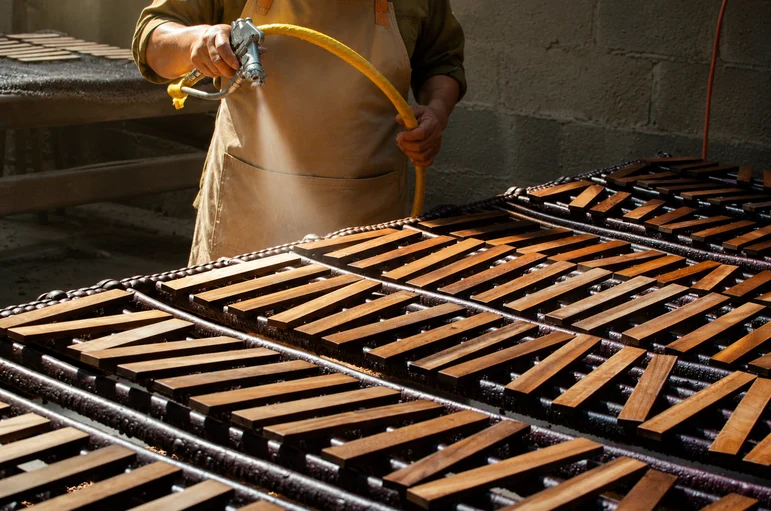
German consumer sentiment toward dining out has shifted decisively toward Biophilic Design—integrating natural textures, warm timber tones, and organic curves into restaurant interiors and tableware. Plastic-free dining initiatives led by the Federal Ministry for the Environment (BMUV) have accelerated commercial demand for renewable hardwood alternatives.
Furthermore, modern European consumers judge brand authenticity based on environmental ethics. By partnering with an FSC-certified factory like Nineteen Intertrade, Berlin procurement managers can verify that every wooden salad bowl delivered to their warehouse contributes to responsible forest management and fair labor practices backed by SMETA factory audits.
Vertical integration ensures absolute quality control from raw log conversion to export container loading.
Only Grade-A heartwood from plantation-reforested Acacia and Teak is selected. Defective knots and sapwood variations are systematically culled before processing.
Combining 5-axis computer numerical control (CNC) lathe turning with traditional master artisan hand-sanding achieves perfectly uniform wall thicknesses and smooth tactile curves.
Every bowl undergoes strict dimensional checks, moisture level verification via electronic pin meters, and visual grain inspection prior to custom gift packing and container sealing.
Essential insights regarding commercial ordering, custom branding, regulatory documentation, and bulk logistics.
Empower your commercial tableware line with certified Thai hardwood craftsmanship. Download our comprehensive OEM product catalog, material safety sheets, and wholesale price lists today.