
Discover expert insights, manufacturing processes, wood care guides, and industry trends from Thailand's leading OEM wooden kitchenware & furniture exporter.
Choosing an end grain chopping board is no longer only a matter of kitchen style. Global buyers now compare durability, hygiene, wood origin, size, weight, and replacement value.
Market evidence supports this wider view. Grand View Research identifies growing demand for premium kitchenware, supported by home cooking and food-service expansion. Fortune Business Insights also reports steady growth in the global cutting board market, although published estimates differ by research method. That difference deserves attention. Market numbers are useful, but they do not measure board stability, glue quality, or daily knife marks.
Food safety remains central. The U.S. Department of Agriculture recommends using separate boards for raw meat and ready-to-eat foods. The U.S. Food and Drug Administration also emphasizes clean, smooth, and maintainable food-contact surfaces. Dr. Dean O. Cliver, a respected researcher in food microbiology, stated that “wooden cutting boards are not inherently unsafe.” His research challenged the simple belief that plastic is always safer.
Real use tells another story. A well-built end grain chopping board absorbs repeated knife impact through its vertical wood fibers. It feels quieter under a chef’s knife. It may also resist deep scoring better than many flat-grain alternatives. Still, no board is maintenance-free. Water, heat, poor drying, and careless cleaning can cause warping or cracks.
This guide examines ten leading options for international buyers. It considers craftsmanship, wood species, dimensions, certification signals, maintenance demands, and practical value. Some rankings remain debatable. That is honest. A beautiful board can still be too heavy, too expensive, or unsuitable for a humid kitchen.
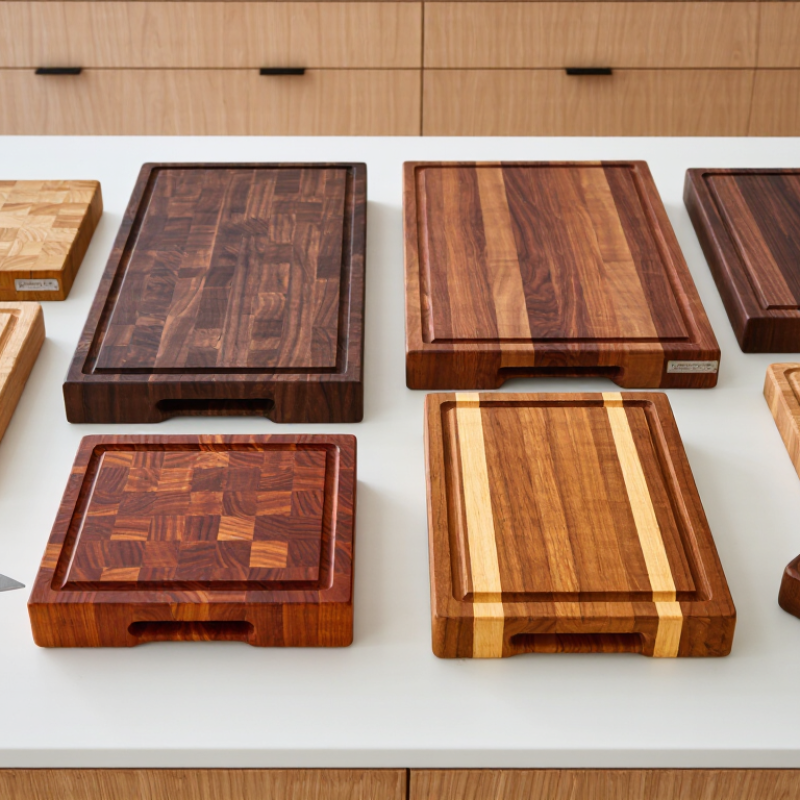
For global buyers, end grain chopping boards stand out because their wood fibers face upward. Instead of cutting across long fibers, a knife enters the fiber ends. This structure can reduce visible scoring and soften the impact on a sharp edge. In practical kitchen testing, the board often feels quieter under a cleaver. It is not magic. Hard ingredients still leave marks.
The block-like construction also gives the board strength, but it adds weight. A thick board stays steady while chopping onions, herbs, or dense squash. Small wood pieces can absorb moisture at their exposed ends, so careless washing may cause swelling or cracks. Wipe it promptly, let both sides dry, and apply suitable food-contact mineral oil when the surface looks pale. Avoid soaking it overnight. That mistake is common.
Experienced purchasers should inspect more than appearance. Ask about wood species, moisture control, joint quality, flatness, and finishing materials. A smooth surface should not feel waxy or shed loose fibers. Rounded edges improve handling, while rubber feet can reduce movement but may complicate cleaning. Wood grain patterns vary, and minor color differences are normal. I would not promise a board will remain perfect; usage, climate, and care decide that. For international shipments, stable packaging and clear maintenance instructions matter almost as much as the board itself.
Wood choice shapes weight, wear, and moisture response. Hard maple is dense and close-grained, giving knives a firm, even surface. Walnut feels slightly softer under the blade and brings a darker, warmer appearance. The USDA Forest Products Laboratory’s Wood Handbook reports specific gravity values of about 0.63 for hard maple and 0.55 for black walnut, based on wood density and moisture content. Those figures help compare species, but they do not predict board quality alone. Grain orientation and workmanship matter, too.
End-grain construction places the wood fibers upright, so knife edges slip between them rather than repeatedly cutting across long fibers. This can reduce visible scoring, though it does not make a board immune to damage. Look closely at glue lines, block alignment, and the board’s finish. Gaps can trap food and moisture. Not ideal. A thick board may feel stable on a counter, but it is heavier to lift and harder to dry evenly. End grain can also cost more because it takes extra cutting and assembly.
Moisture control matters across climates. The USDA handbook documents how wood dimensions change as moisture content shifts; buyers should therefore check whether a board is dried and sealed appropriately. Ask suppliers about kiln drying, food-contact-safe finishes, and care instructions. Small details count. A board that rocks slightly or has uneven joints may become frustrating in daily use. Even well-made wood needs washing by hand and prompt drying. That is practical, not glamorous.
The Top 10 End Grain Chopping Boards Compared
A useful comparison starts with construction, not appearance. End-grain boards place wood fibers upright, creating a patterned surface that can accommodate knife marks. That does not make every board equally durable. Look for tight, consistent joints, a stable base, and enough thickness to resist rocking. Hard maple, walnut, and cherry are common choices, but wood species alone cannot predict service life. Grain layout, glue lines, drying, and daily care matter too. A beautiful board can still warp. It happens.
Among ten candidates, compare weight, working area, juice grooves, handles, and maintenance needs. A compact board is easier to lift and wash; a heavier board may stay steadier during chopping. Grooves help contain liquid, yet reduce usable cutting space. USDA FSIS advises using separate cutting boards for raw meat and ready-to-eat foods, making cleanability and sensible kitchen routines part of the comparison. CDC estimates that foodborne illnesses affect about 48 million people in the United States each year. This estimate is a reminder that board choice cannot replace careful food handling.
For global buyers, assess moisture exposure, packaging, and replacement parts, not just price. End grain needs regular drying and conditioning, and prolonged soaking is a poor idea. Ask suppliers for wood-species identification, construction details, and care instructions. These details are not glamorous. They are useful. One weakness in many comparisons is limited long-term testing: a board may look flawless in a product photo, yet its performance after repeated washing is less certain. Look for evidence, and treat unsupported durability claims cautiously.
How to read this chart: Janka hardness measures the force required to embed a steel ball halfway into wood; higher values indicate harder wood, not necessarily a better chopping board. Values shown are standard species-level ratings in pounds-force (lbf), and actual wood can vary. Board performance also depends on construction, grain orientation, thickness, and care.
Choosing an end-grain board is less about ranking and more about matching its size, weight, and care needs to your kitchen. A broad, heavy board suits frequent vegetable prep and stays steady while you chop. A compact board is easier to lift and store, especially in a small kitchen, but offers less room for separating ingredients. End-grain construction exposes wood fibers at the cutting surface, which can help limit visible knife marks; it does not make a board self-cleaning or immune to wear. USDA estimates foodborne illness costs the United States billions of dollars annually, a reminder that safe handling matters as much as the surface itself. Wash boards after use, and keep raw-meat prep separate from ready-to-eat foods.
Tips: Match board thickness to how often you move it. Check that it sits flat, has a practical grip, and can dry fully on both sides. For households with varied cooking routines, two boards may be more useful than one oversized board. Drying takes space. That detail is easy to overlook.
A deep, thick board can feel reassuring during heavy chopping, yet it may be awkward to clean in a small sink. A lighter option is easier to handle, though it can shift unless placed on a damp towel. End grain also needs attentive care: dry it promptly and follow the maker’s instructions for periodic conditioning. No board is entirely carefree, and the best choice may be the one your kitchen can maintain consistently.
Before importing end grain chopping boards, ask for the wood species, construction details, and moisture-control records. End grain exposes many short wood fibers, so uneven drying can cause checks or board movement. The USDA Forest Products Laboratory’s Wood Handbook (2021) gives equilibrium moisture content of about 6.2% at 70°F and 30% relative humidity, rising to about 13% at 70% humidity. That gap matters. Request moisture readings from several boards, not one sample, and confirm the measuring method and production date. A neat inspection photo is useful, but it cannot show internal moisture variation.
Check that the declared species matches the shipment documents and any required sourcing records. Ask whether the boards use adhesives, coatings, or edge treatments, and request relevant food-contact test reports for the intended market. Do not treat a generic certificate as proof for every finish or production batch. Inspect sample boards for open glue lines, trapped debris, rough edges, and cracks around the perimeter; then agree on measurable acceptance criteria before ordering. Packaging deserves attention too. Boards should be protected from moisture swings, but sealed wet wood can develop problems in transit. I would ask for carton-level packing details and a pre-shipment inspection. It may feel overly cautious. A few minutes spent checking records can prevent a container of inconsistent boards.
Its wood fibers face upward. Knife edges enter the fiber ends, which can reduce visible scoring. It is not magic.
It may soften the impact on a sharp edge. The board can feel quieter under a cleaver. Hard ingredients still leave marks.
Compare density, grain pattern, moisture response, and workmanship. A dense wood feels firm, while a softer wood may feel gentler. Species alone does not decide quality.
A thick board stays steady during onion, herb, or squash preparation. It also weighs more and dries more slowly. That trade-off matters.
Check flatness, block alignment, glue lines, and surface finish. Avoid gaps that could trap food or moisture. Loose fibers are a warning sign.
Wash it by hand after use. Wipe away water promptly, then dry both sides. Never soak it overnight.
Apply suitable food-contact mineral oil when the surface looks pale. Follow the care instructions provided with the board. I would not condition it blindly.
A compact board is easier to lift and store. A broad board gives more room for separating ingredients. Measure the sink and storage space first.
Not always. Separate raw-meat preparation from ready-to-eat foods. Two smaller boards may work better than one oversized board.
Choose a flat board with practical grips or stable feet. A lighter board can sit on a damp towel. Cleaning around feet may become annoying.
An end grain chopping board is made by arranging wood fibers vertically, creating a durable cutting surface that can help reduce visible knife marks and withstand regular kitchen use. Its performance depends on factors such as wood species, grain quality, board thickness, construction, and maintenance needs. Comparing ten types of boards can help buyers understand the differences in durability, weight, surface feel, and suitability for everyday food preparation.
The right choice depends on the kitchen: a compact board may suit limited counter space, while a larger, heavier option can provide stability for frequent chopping. Global buyers should also check product dimensions, materials, finish, packaging, shipping requirements, and supplier quality controls before importing. Considering these details makes it easier to select a board that meets practical needs and arrives ready for reliable use.