
0%

Finding a dependable private label woodenware supplier requires more than comparing catalog prices. It requires evidence.

The global wooden kitchenware market is gaining attention as retailers seek renewable, tactile, and reusable products. Grand View Research identifies product design, material quality, and distribution capability as important market factors. Meanwhile, the FAO’s The State of the World’s Forests 2024 stresses responsible forest management and traceable supply chains. These findings matter when a supplier offers bamboo boards, acacia spoons, or beechwood utensils.

Kim Carstensen, former Director General of the Forest Stewardship Council, said, “Forests are more than just trees.” His point applies directly to private label woodenware. A polished product can still hide unclear species, weak labor controls, or poor finishing practices.

Look beyond attractive samples. Ask for wood-species declarations, moisture-control records, food-contact test reports, and coating specifications. Check whether the supplier can provide FSC chain-of-custody documentation when certified material is claimed. Review factory audit dates, corrective-action records, and production photographs. A supplier that avoids specific answers deserves caution.

Small details expose real capability. Inspect the smoothness around a spoon’s bowl. Rub a cutting board’s edge with a dry cloth. Check whether laser engraving remains readable after washing. These practical tests are often more revealing than a presentation deck.

No supplier is perfect. That is the uncomfortable part. Even a certified factory may miss a shipment deadline or produce inconsistent color. Reliable sourcing means verifying risks, recording compromises, and improving controls over time. This guide explains how to evaluate suppliers with clearer evidence, stronger questions, and fewer assumptions.
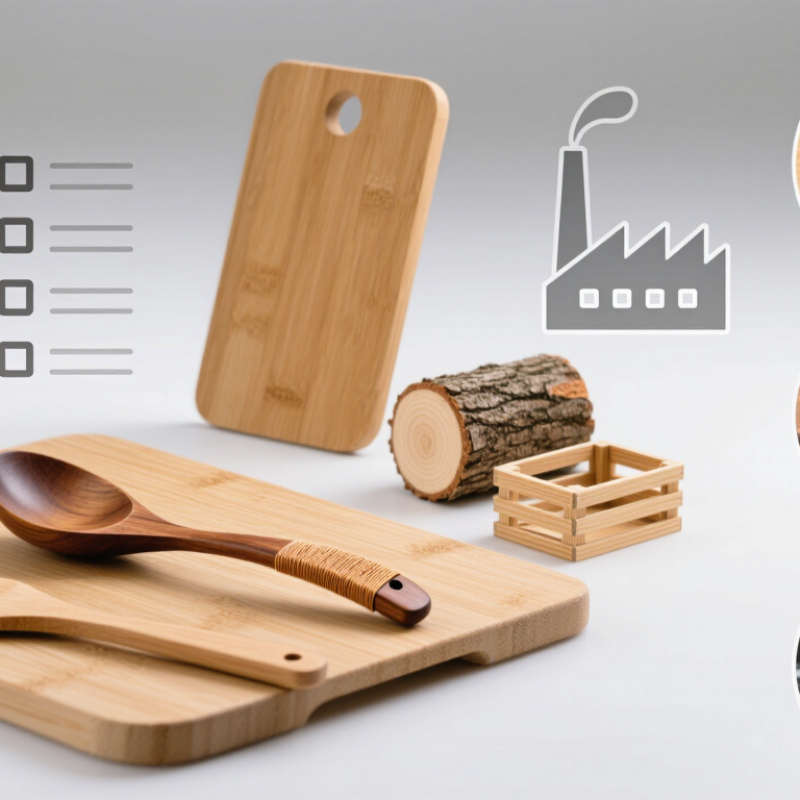
How to Find Reliable Private Label Woodenware Suppliers?

Define Your Private Label Woodenware Requirements

Before contacting private label woodenware suppliers, define the product in measurable terms. A vague request creates expensive misunderstandings. Record the item’s length, width, thickness, weight, and acceptable measurement tolerance. Specify the wood species, grain direction, edge shape, and surface texture. For example, a serving board may require rounded edges, a 30-centimeter length, and a smooth matte finish.

Describe how the woodenware will be used. Food-contact products need suitable materials, safe finishes, and clear care instructions. Ask for moisture control during production and storage. Excess moisture can cause warping, cracking, or unpleasant odors. Request samples from the proposed production process, not only polished showroom pieces. Check the sample under bright light. Look for uneven sanding, glue marks, rough corners, and inconsistent color.

Your private label requirements should also cover logo placement, engraving depth, label size, packaging materials, carton strength, and shipping marks. Provide artwork in an editable format, but confirm its final size on the product. A logo can look balanced on paper and crowded on a small utensil. Ask suppliers about minimum order quantities, sample fees, production lead times, inspection procedures, and replacement policies. Written answers are useful evidence of professionalism. Still, suppliers may miss details. I have learned that one unchecked assumption can affect an entire shipment. Start with a small trial order when possible, then review defects, packaging damage, and customer handling feedback before increasing volume.

Research and Shortlist Potential Woodenware Suppliers

Researching private label woodenware suppliers requires more than comparing catalog photos. Start with a clear product brief. Record the intended wood species, dimensions, moisture tolerance, surface finish, packaging, and target order quantity. A supplier who asks precise questions may understand production risks better than one offering instant quotations.

Request recent samples from at least five potential suppliers. Inspect the grain, edges, joints, weight, odor, and finish under normal kitchen lighting. Check whether measurements match the specification. Ask for material documentation, factory quality procedures, production capacity, lead times, and relevant testing records. Photos are useful, but physical samples reveal more.

Keep a shortlist with evidence, not impressions. Compare response speed, sample consistency, minimum order quantities, payment terms, and replacement policies. Contact two trade references when possible. A video factory tour can help, although it is not a complete audit.

I once favored a polished presentation and overlooked vague quality records. That mistake was expensive. Now I ask suppliers to explain how they control warping, cracking, moisture changes, and color variation. Their answers often expose weak processes.

Do not choose the cheapest quotation automatically. A low price may exclude inner packaging, inspection, or protective finishing. Request a small pilot order before scaling. Measure defect rates and inspect cartons after transport. Some evaluations remain uncertain, especially when communication is slow or specifications change. Record those doubts instead of hiding them. Reliable sourcing depends on repeatable evidence, careful questions, and a willingness to revise the shortlist.

Evaluate Supplier Quality, Certifications, and Production Capacity

Reliable private label woodenware suppliers should be judged through evidence, not polished samples. In supplier audits, check moisture content, sanding quality, edge smoothness, coating adhesion, and odor after washing. A beautiful prototype can hide weak batch control. It happens.

Certification adds structure, but it does not replace inspection. The ISO Survey 2022 recorded 1,265,216 ISO 9001 certificates worldwide. Ask whether the certificate covers the actual factory and woodenware process. Verify its registration, scope, and validity. For timber traceability, request chain-of-custody records and species documentation. The Forest Stewardship Council’s 2023 facts report listed more than 160 million certified forest hectares globally. That figure supports responsible sourcing, but it cannot prove finished-product quality.

Production capacity needs physical verification. Request monthly output records, kiln capacity, machine lists, staffing levels, and recent delivery performance. Compare the supplier’s claimed capacity with your forecast, including seasonal peaks. Inspect separate areas for raw timber, drying, finishing, and packed goods. Use a pilot order with measurable standards: moisture below your agreed limit, no splinters, consistent dimensions, and packaging drop-test results. Independent laboratory testing can check coating migration and food-contact safety where relevant. Do not rely on factory photographs alone. I would still keep a second qualified supplier, because capacity spreadsheets often look stronger than reality.

Compare Samples, Pricing, Minimum Orders, and Lead Times

How to Find Reliable Private Label Woodenware Suppliers?

A dependable supplier should survive a practical sample review, not just send polished photographs. Request identical samples from three factories. Check grain direction, sanding quality, edge smoothness, coating odor, and moisture content. Use a moisture meter when possible. Uneven moisture can cause warping after shipment.

Pricing needs a clear breakdown. Ask for wood grade, finishing, packaging, tooling, inspection, and shipping terms. Compare the landed cost, not only the unit price. The Food and Agriculture Organization’s Global Forest Resources Assessment 2020 recorded about 4.06 billion hectares of forest worldwide. That scale does not guarantee responsible or consistent sourcing. Request species information and supporting traceability documents. I once accepted a cheaper quote with unclear packaging costs. The final invoice was higher.

Minimum order quantities should match your sales forecast. A low MOQ may carry higher unit pricing, but it can reduce cash pressure and inventory risk. Ask whether mixed colors, sizes, or designs are allowed within one order. A supplier refusing small pilot runs deserves caution. So does one offering unusually low prices.

Lead times must include sampling, production, inspection, and port handling. The World Bank’s 2023 Logistics Performance Index compares customs, infrastructure, shipment quality, and timeliness across 139 economies. Use those factors when judging a supplier’s delivery plan. Request a dated production schedule and a clear delay procedure. Add buffer time. Woodenware can need extra drying or rework, and suppliers may underestimate both. A signed schedule helps, but it is not proof of capacity. A factory video is useful. An independent inspection is better.

How to Find Reliable Private Label Woodenware Suppliers? - Compare Samples, Pricing, Minimum Orders, and Lead Times

Anonymous supplier comparison based on commonly quoted private-label woodenware benchmarks

Evaluation Criteria Supplier Profile A Supplier Profile B Supplier Profile C Supplier Profile D
Typical Product Focus Wooden spoons, spatulas, and serving utensils Cutting boards and serving boards Wooden bowls, trays, and kitchen accessories Mixed woodenware gift sets and hospitality items
Common Wood Options Beech, rubberwood, acacia Acacia, bamboo, rubberwood Beech, birch, olive wood Rubberwood, bamboo, acacia
Sample Cost US$20–60 per design, usually excluding freight US$30–90 per design, usually excluding freight US$25–80 per design, usually excluding freight US$35–100 per set, usually excluding freight
Sample Lead Time 7–14 calendar days 10–18 calendar days 10–20 calendar days 14–25 calendar days
Estimated Unit Price at 1,000 Units US$1.20–3.80 US$3.50–12.00 US$2.80–9.50 US$6.00–18.00 per set
Typical Minimum Order Quantity 300–500 units per design 200–500 units per design 300–800 units per design 500–1,000 sets per design
Private-Label Customization Laser logo, color sleeve, barcode label Laser or branded engraving, custom packaging Logo engraving, printed box, insert card Logo, gift box, paper wrap, bundled sets
Estimated Customization Charge US$0.05–0.25 per unit after tooling US$0.08–0.35 per unit after tooling US$0.10–0.40 per unit after tooling US$0.30–1.50 per set, depending on packaging
Bulk Production Lead Time 25–40 calendar days after approval 30–50 calendar days after approval 35–55 calendar days after approval 40–65 calendar days after approval
Finishing Options Food-grade oil, natural finish, light staining Food-grade oil, mineral oil, wax finish Oil finish, water-based coating, natural finish Oil finish, wax finish, selected color coating
Quality Checks to Request Moisture content, splinters, edge smoothness, logo placement Warping, cracking, thickness, flatness, food-contact finish Wall thickness, roundness, surface defects, finish consistency Set completeness, packaging strength, finish, dimensional tolerance
Documentation to Verify Material specification, food-contact declaration, packing list Material specification, finish details, inspection report Wood species declaration, coating information, carton details Complete bill of materials, packaging artwork approval, inspection report
Best Fit for Buyers Small brands testing simple utensil designs Brands prioritizing premium boards and higher perceived value Retailers requiring varied shapes and moderate customization Established brands ordering coordinated gift collections

Note: Prices, quantities, and lead times are typical industry ranges for private-label woodenware and should be confirmed in writing after the wood species, dimensions, finish, packaging, destination, and inspection requirements are finalized.

Verify Agreements, Branding Services, and Ongoing Support

Reliable private label woodenware suppliers do more than offer attractive samples. They provide clear agreements that describe wood species, moisture levels, dimensions, finishes, packaging, pricing, and delivery dates. Request a written sample approval process. It should explain who pays for replacements when products arrive cracked, warped, or poorly finished. Vague promises create expensive problems later.

Tips: Ask for a small trial order before committing to larger quantities. Check the supplier’s quality records, production photos, inspection methods, and export experience. Discuss branding services in practical detail. Can they engrave a logo evenly? Can they match packaging colors? Will they send artwork proofs before production? Request a physical branding sample, not only a digital image. Small details matter.

Ongoing support is equally important. Confirm response times, reorder procedures, spare packaging, and after-sales handling. A dependable contact should remain available after the first shipment. Ask how they manage changes in wood availability or finishing results. A supplier may answer quickly during negotiations, then become difficult later. That risk is easy to underestimate. Review every agreement carefully, including tolerances and corrective actions. Even careful buyers miss details. Recheck them before approval.

FAQS

How can I test a woodenware supplier before placing a large order?

Request identical samples from three factories. Compare grain direction, sanding, edges, coating odor, and moisture content. Inspect closely.

Why is moisture content important in woodenware?

Uneven moisture can cause warping after shipment. Use a moisture meter when possible. Dry wood is not always stable wood.

What costs should a supplier quotation include?

Ask for wood grade, finishing, packaging, tooling, inspection, and shipping terms. Compare total landed cost, not unit price alone.

How can I check responsible wood sourcing?

Request the wood species and traceability documents. Large forest resources do not guarantee consistent or responsible sourcing.

What minimum order quantity is practical for a new product?

Match the order to your sales forecast. A smaller trial order may cost more per unit, but reduces inventory pressure.

Should a supplier allow mixed colors, sizes, or designs?

Ask before approval. Mixed options can improve testing flexibility. A supplier refusing small pilot runs deserves careful review.

What should a realistic production schedule contain?

Include sampling, production, inspection, port handling, and buffer time. Woodenware may need extra drying or rework.

Is a factory video enough to confirm production capacity?

No. A video offers useful context, but independent inspection provides stronger evidence. Photos can hide ordinary problems.

What details should a private label agreement specify?

Confirm wood species, moisture levels, dimensions, finishes, packaging, prices, delivery dates, and acceptable tolerances.

How should branding quality be approved?

Request a physical engraving and packaging sample. Check logo alignment, color matching, and artwork proofs before production. Digital images can mislead.

What support should continue after the first shipment?

Confirm response times, reorder procedures, spare packaging, and after-sales handling. A quick negotiator may later become difficult.

What should happen when products arrive damaged or poorly finished?

The agreement should explain replacement costs and corrective actions. Vague promises create expensive disputes. Recheck everything before approval.

Conclusion

Finding reliable private label woodenware suppliers begins with clearly defining your product requirements, including wood type, dimensions, design, finish, packaging, target market, and expected order volume. With these details in place, research potential suppliers and create a shortlist based on their experience, communication, manufacturing capabilities, and ability to support customized production. Review their quality control procedures, relevant certifications, sourcing practices, and production capacity to determine whether they can consistently meet your standards.

Before making a decision, compare samples carefully for craftsmanship, durability, safety, and design accuracy. Evaluate pricing, minimum order quantities, payment terms, and lead times to ensure the partnership fits your budget and schedule. It is also important to confirm branding options, such as engraving, labeling, packaging, and product inserts. Finally, verify that all agreements clearly cover specifications, quality expectations, delivery responsibilities, and after-sales support. A dependable supplier should offer transparent communication, practical solutions, and ongoing assistance as your private label woodenware business grows.

Ethan

Ethan

Ethan is a professional marketing specialist and a dedicated contributor to our company’s online knowledge center. With a strong understanding of our products, industry trends, and customer needs, he regularly creates clear, practical, and informative blog articles that help readers make confident......