
For wholesale buyers, choosing an acacia wood salad bowl involves more than admiring its warm color. Grain direction, wall thickness, moisture control, finish quality, and supplier consistency can affect every shipment. A bowl that looks beautiful in a showroom may arrive with uneven edges, strong odors, or inconsistent sizing. Small details matter.
Woodturning authority Richard Raffan expresses the central design principle clearly: “A bowl should feel right before it looks right.” That idea suits commercial buying. Restaurant staff need a bowl that feels balanced, sits securely, and withstands repeated handling. Retail customers also notice smooth rims, natural grain, and practical proportions.
This guide reviews seven acacia wood salad bowl options for wholesale buyers. It considers capacity, construction, finish, packaging, care requirements, and visual appeal. It also asks harder questions about sourcing claims and long-term performance. “Natural” does not automatically mean durable or responsibly produced. Suppliers should provide clear material information and explain their finishing process.
Expect variation.
Acacia is a natural material. No two bowls will match perfectly. That variation can create a premium appearance, but it may complicate large retail sets. Buyers should request samples, measure several units, inspect the underside, and test the surface with ordinary salad ingredients. A rushed order can expose hidden weaknesses later.
The strongest choices balance attractive presentation with dependable production standards. They should support profitable resale without sacrificing everyday usability. Some options may look impressive but require more careful maintenance. Others may offer simpler designs, easier packing, and better consistency. This comparison helps buyers judge both strengths and limitations before committing to volume.
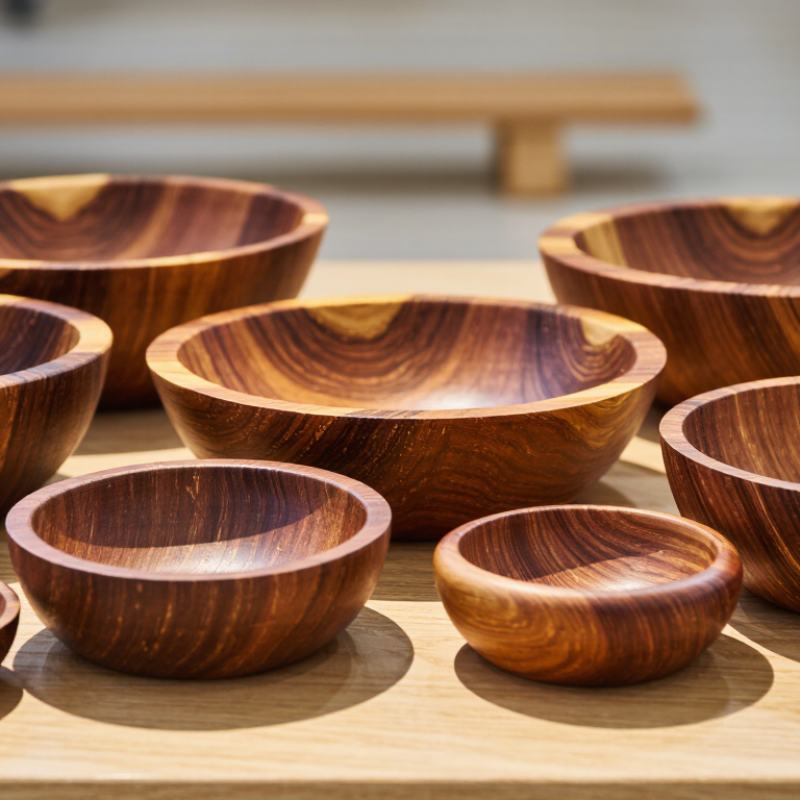
Acacia wood salad bowls suit wholesale buyers because they balance durability, appearance, and manageable cost. During product sampling, I check the bowl’s wall thickness, weight, sanding, and surface finish. A stable bowl feels solid without becoming difficult to ship. That matters for restaurants, gift shops, and homeware retailers. Acacia’s natural grain also gives each piece a warm, varied appearance. Customers notice that difference on open shelves. However, color and grain are never perfectly identical. Buyers should accept reasonable variation or set clear grading standards.
Moisture resistance is another practical advantage, but acacia is not maintenance-free. Suppliers should provide care instructions, including hand washing and immediate drying. A food-contact-safe finish is essential. Request test records and material details before placing a large order. Consistent sizing supports efficient carton packing and predictable retail displays. Nested bowls can reduce shipping volume. Packaging still needs careful testing. I have seen attractive bowls arrive with rubbed edges after weak internal protection. Small defects become expensive at wholesale scale. Buyers should compare sample quality, replacement policies, lead times, and production capacity before selecting from the seven best options. Bulk pricing matters, but reliable consistency matters more.
A practical comparison of common acacia wood salad bowl formats for hospitality, kitchenware, gift, and retail purchasing programs.
| Rank | Wholesale Bowl Format | Typical Diameter | Typical Capacity | Recommended Use | Wholesale Advantages | Care and Compliance Notes |
|---|---|---|---|---|---|---|
| 1 | Large Family Serving Bowl | 30–35 cm 11.8–13.8 in |
3.5–5.0 L | Family salads, shared side dishes, buffet presentation, and catering service. | High visual impact; broad retail appeal; suitable for premium tableware collections; efficient for seasonal gift and wedding-registry programs. | Use for serving rather than prolonged food storage. Hand wash with mild soap, dry immediately, and periodically condition with food-safe mineral oil. |
| 2 | Medium Everyday Salad Bowl | 25–29 cm 9.8–11.4 in |
2.0–3.2 L | Daily household salads, pasta, fruit, snacks, and side dishes. | Best all-purpose size; easier to merchandise; balances useful capacity with manageable shipping volume; suitable for broad consumer demand. | Acacia is naturally hard and moisture-resistant, but the bowl should not be placed in a dishwasher, microwave, oven, or refrigerator. |
| 3 | Small Individual Serving Bowl | 15–19 cm 5.9–7.5 in |
0.5–1.0 L | Individual salads, cereals, desserts, condiments, and small side portions. | Lower unit volume; convenient for multi-piece sets; economical for entry-level retail assortments and hospitality room service. | Specify a smooth, food-contact-safe finish and rounded edges. Store in a dry, ventilated area to reduce the risk of warping. |
| 4 | Deep Mixing and Serving Bowl | 26–32 cm 10.2–12.6 in |
2.5–4.5 L | Mixing salads, tossing vegetables, preparing cold dishes, and serving larger portions. | Functional depth helps reduce spills; versatile product positioning allows use in both preparation and presentation; strong fit for kitchenware assortments. | Do not use as a chopping surface. Avoid soaking, abrasive cleaners, and prolonged contact with highly pigmented or acidic foods. |
| 5 | Nested Bowl Set | 15–30 cm 5.9–11.8 in |
0.5–3.5 L per bowl | Multi-purpose household use, gift sets, wedding collections, and coordinated kitchen ranges. | Space-efficient nesting lowers shelf and warehouse requirements; multiple price points can be created from one coordinated set; attractive for gift packaging. | Each bowl should be inspected for consistent wall thickness, stable bases, smooth interiors, and secure packaging protection between nested pieces. |
| 6 | Wide Low-Profile Salad Bowl | 28–34 cm 11.0–13.4 in |
2.5–4.0 L | Modern table settings, composed salads, grazing tables, and restaurant presentation. | Strong presentation value; wide opening makes food easy to arrange and serve; suitable for contemporary home décor and hospitality channels. | A wide base should sit level on the table. Protective cartons or molded inserts are recommended because the broad rim can be more exposed during transport. |
| 7 | Handled or Footed Serving Bowl | 24–30 cm 9.4–11.8 in |
1.8–3.5 L | Entertaining, outdoor dining, buffet service, and decorative serving displays. | Distinctive merchandising feature; handles or a raised foot improve handling and presentation; supports differentiated product lines beyond basic bowls. | Check handle joints and foot stability during quality control. Keep away from direct heat and confirm that all decorative coatings are suitable for food-contact use. |
Wholesale selection criteria: Prioritize consistent dimensions, stable construction, smooth food-contact surfaces, responsible wood sourcing, protective packaging, and clear care instructions. Acacia wood products are generally intended for hand washing and should be kept away from dishwashers, microwaves, ovens, and prolonged soaking.
Round, wide-rim, deep, footed, segmented, handled, and nested styles serve different needs. Space matters.
Classic round bowls suit salads and broad household use. Small sizes may sell well as individual serving pieces. Demand still varies.
Inspect several samples under bright light. Check smooth rims, stable bases, even walls, balanced weight, and natural grain variation. One attractive sample proves little.
Add salad dressing, wash bowls gently by hand, dry them, stack them, and handle them repeatedly. Look for swelling, roughness, color transfer, or warping. Catalog images hide problems.
Request food-contact reports for finishes, adhesives, and colored treatments. Confirm the tested material, laboratory, date, and relevant market requirements. “Natural” alone is not proof.
Poorly dried wood may warp after delivery. Excessive coating can hide weak sanding or uneven wood. Ask for moisture targets, drying records, and care instructions.
Compare defect allowances, carton counts, lead times, packaging strength, and reorder consistency. A 12-inch bowl may increase shipping costs. Small scratches become expensive across hundreds of units.
Ask for wood species, harvest origin, traceability documents, packaging details, and worker protection records. Check whether offcuts are reused. Some answers may remain incomplete, so record that uncertainty.
Acacia wood salad bowls are a practical and attractive choice for wholesale buyers because they offer natural durability, distinctive grain patterns, and a warm presentation suitable for restaurants, retailers, and hospitality settings. This guide reviews seven styles worth considering, including classic round bowls, deep serving bowls, nesting sets, footed designs, segmented bowls, handled bowls, and compact individual portions. Each style can serve different customer needs, from everyday dining to elegant table presentation.
Before placing a wholesale order, buyers should compare bowl dimensions, thickness, capacity, finish, weight, packaging, and production consistency. Quality and safety checks should include smooth surfaces, secure construction, food-contact-safe finishes, proper moisture control, and responsible sourcing practices. The article also explains how to assess sustainability claims, estimate pricing, request customization such as sizes or logos, and evaluate suppliers based on communication, samples, lead times, minimum order quantities, and quality control. A thoughtful comparison helps buyers select an acacia wood salad bowl collection that balances appearance, function, cost, and long-term value.
