
Choosing the right wooden pastry board matters more than its appearance. A beautiful board can still warp, stain, or slide during daily production. Global buyers need dependable evidence, not vague promises.
Pastry chef and baking author Edd Kimber offers a useful principle: “Good equipment should make the process easier, not become the process.” That idea suits every wooden pastry board considered for 2026. The best options provide a stable surface for rolling dough, shaping biscuits, and cutting pastry. Their grain should feel smooth beneath the palm. Their edges should remain comfortable during repeated handling. A board that moves across a marble counter is not truly practical.
Material selection deserves close attention. Hard maple, beech, and acacia often provide useful durability, but density alone does not guarantee performance. Buyers should check moisture control, board thickness, surface treatment, glue safety, and cleaning guidance. End-grain construction may resist knife marks, while wide edge-grain boards can offer easier storage and lower costs. Details matter.
Still, no board is perfect. Wood absorbs moisture, and careless soaking may shorten its life. Some product descriptions also sound stronger than their testing evidence. That deserves skepticism. This guide compares leading 2026 models through construction, usability, maintenance, packaging, and supplier reliability. It also considers different working spaces, from compact home kitchens to busy bakery counters. The strongest wooden pastry board is not always the largest or most expensive. It is the one that remains steady, clean, repairable, and useful after many batches.
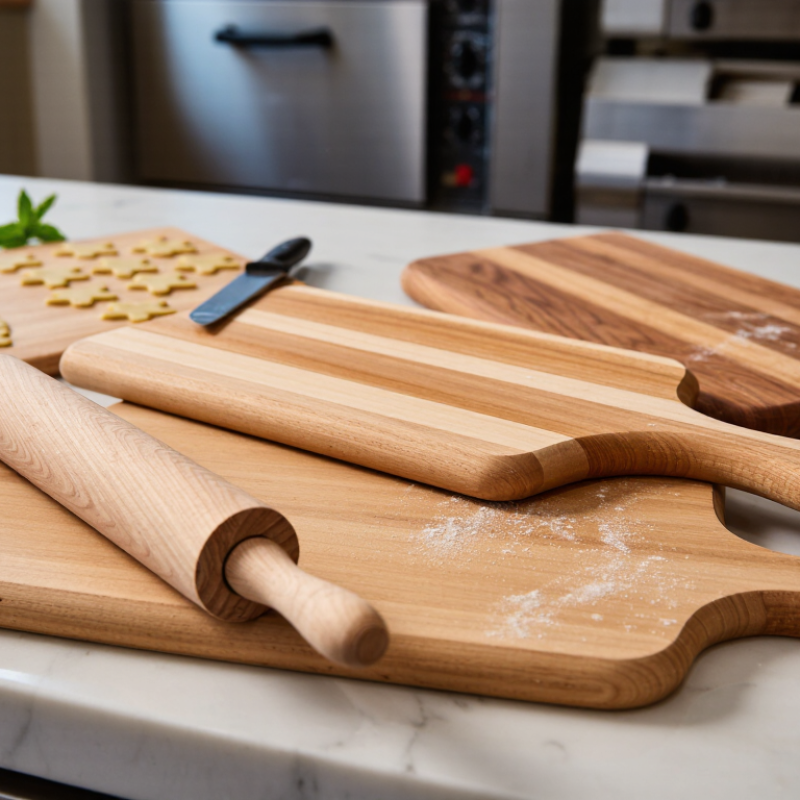
A high-quality wooden pastry board in 2026 should feel stable before it looks attractive. In a working kitchen, I test whether it stays flat while rolling chilled dough. A board that rocks slightly can distort a tart shell and frustrate the baker.
Material choice matters. Dense hardwood with a tight grain usually resists deep knife marks and moisture absorption. The surface should be smoothly sanded, but not polished until it becomes slippery. A practical board often measures at least 20 millimeters thick, with rounded edges that feel comfortable during long preparation sessions. Food-contact-safe oil or wax should be clearly identified by the supplier. Strong chemical odors are a warning sign.
Carefully fitted joints also reveal quality. Wide boards made from joined pieces need even seams, clean adhesive lines, and no visible gaps. Buyers should request information about wood origin, moisture control, finishing materials, and cleaning instructions. These details support dependable purchasing across different markets. They also make supplier claims easier to verify.
No board is perfect. Even good wood can expand in humid weather or develop light scratches after repeated use. I have learned that washing a pastry board under running water is convenient, but damaging over time. Wiping it promptly works better. Still, I would like manufacturers to provide clearer repair guidance, because many buyers replace boards that could be sanded and resealed. A reliable board should support daily baking, not merely appear impressive in product photographs.
Global buyer comparison based on practical pastry performance, food-contact suitability, durability, maintenance, and shipping considerations.
| Board Profile | Recommended Wood | Typical Working Size | Recommended Thickness | Approx. Weight | Best Pastry Applications | Key Quality Indicators | Care Requirements | Buyer Suitability |
|---|---|---|---|---|---|---|---|---|
| Compact Home Baker Board | Beech, maple, or rubberwood | 40 × 30 cm (15.7 × 11.8 in) |
18–22 mm (0.7–0.9 in) |
1.5–2.2 kg | Cookies, tart dough, small pie crusts, and everyday baking | Flat surface; smooth sanding; no open cracks; rounded edges; stable grain direction | Hand-wash only; dry immediately; re-oil approximately every 1–3 months with food-grade mineral oil | Efficient for apartments and smaller kitchens |
| Standard Family Pastry Board | Maple, beech, or acacia | 50 × 35 cm (19.7 × 13.8 in) |
20–25 mm (0.8–1.0 in) |
2.5–3.8 kg | Pie dough, biscuits, pizza dough, and general home pastry work | Low-warp construction; uniform thickness; food-contact finish; gently rounded corners | Keep away from dishwashers and prolonged soaking; store flat or vertically in a dry area | Best all-purpose size for global household use |
| Large Rolling Board | Maple, beech, walnut, or acacia | 60 × 40 cm (23.6 × 15.7 in) |
22–30 mm (0.9–1.2 in) |
4.0–6.5 kg | Large pie bases, laminated dough, croissants, and family-size pizza | High dimensional stability; reinforced construction; precise flatness; sufficient countertop clearance | Use on a dry, level surface; rotate during storage; condition the surface regularly | Strong choice for serious home bakers |
| Reversible Pastry-and-Serving Board | Acacia, maple, beech, or walnut | 45–55 × 30–38 cm (17.7–21.7 × 11.8–15.0 in) |
20–28 mm (0.8–1.1 in) |
2.8–5.0 kg | Rolling dough on one side; bread, cheese, or dessert presentation on the other | Reversible design; smooth non-porous-feeling surface; rounded perimeter; no decorative gaps in the pastry zone | Clean both sides after use; avoid acidic or wet foods remaining on the surface for long periods | Practical for multifunctional kitchens |
| Professional Bakery Work Board | Hard maple, beech, or laminated hardwood | 70 × 45 cm or larger (27.6 × 17.7 in or larger) |
25–35 mm (1.0–1.4 in) |
6.0–10.0 kg | High-volume dough preparation, laminated pastry, bread shaping, and batch production | Commercial-grade flatness; tight joints; rounded working edges; replaceable or refinishable surface preferred | Frequent cleaning and drying; inspect joints routinely; follow local food-contact sanitation procedures | Suitable for bakeries, culinary schools, and workshops |
| Portable Export-Friendly Board | Rubberwood, beech, or engineered solid-wood panel | 45 × 30 cm (17.7 × 11.8 in) |
15–20 mm (0.6–0.8 in) |
1.2–2.5 kg | Travel baking kits, cooking classes, gifting, and compact retail packaging | Lower shipping volume; moisture-stable packaging; protected corners; individually wrapped and clearly labeled | Allow the board to acclimate after delivery; do not expose it to rapid temperature or humidity changes | Useful for international distribution and online retail |
Material note: Weight ranges vary according to wood density, moisture content, construction method, and edge profile. Solid wood boards should not be placed in a dishwasher or left submerged in water, because repeated moisture and heat exposure can cause swelling, cracking, or warping.
Choose dense hardwood with a smooth, splinter-free surface. Close grain usually resists deep knife marks better than soft wood. Beech and maple are common options. Inspect the surface personally.
Wash it by hand with warm water and mild detergent. Dry both faces immediately with a clean towel. Never leave it soaking beside the sink. Standing moisture can cause warping and odors.
Store it upright with air around both sides. Do not place it flat against a damp wall. Drying space matters more than many buyers expect. This detail is easy to miss.
Apply food-safe mineral oil when the surface looks pale or feels rough. Avoid cooking oils because they may turn sticky or rancid. Use a thin coat, then remove excess oil. It does not need to look glossy.
Light sanding can refresh shallow marks. Deep grooves are harder to clean thoroughly. Scrape dried dough with a plastic scraper, not a metal blade. Tiny cuts can hold flour.
Replace it when you find cracks, mold, or persistent warping. Deep cuts may also justify replacement. A beautiful board can still be unhygienic. Appearance alone is not reliable.
Humid regions may need dense hardwood and low-moisture packaging. Dry climates may benefit from a slightly thicker board. Test the board after repeated washing, drying, and kneading. One showroom check is insufficient.
Pastry professionals often need a completely flat surface. Grooves can collect flour and become cleaning problems. Choose features for actual pastry work, not attractive photographs. I would question every extra feature.
Request traceable timber records, food-contact testing, moisture information, and finish details. Sustainability claims need supporting documents. A certificate helps, but it does not replace inspection. Claims can sound better than performance.
Examine the edges, underside, joints, and surface each month. Repeat washing, drying, and kneading during evaluation. Check for movement, odor, splitting, and raised grain. Six months of real use may reveal hidden weaknesses.
Choosing the right wooden pastry board in 2026 requires more than comparing size and appearance. A high-quality board should offer a stable, smooth, food-safe surface that supports rolling, shaping, kneading, and decorating without excessive movement. Wood type affects performance: dense hardwoods provide strength and durability, while lighter woods may be easier to handle but require more careful maintenance. Buyers should also compare thickness, working area, edge design, weight, surface finish, and resistance to moisture or warping.
For global buyers, hygiene and long-term usability are equally important. A reliable wooden pastry board should be easy to clean, dry thoroughly, and maintain with suitable food-safe conditioning products. Regular inspection can help prevent cracks, rough areas, and deep knife marks from affecting food preparation. Different markets may prioritize portability, large preparation space, traditional craftsmanship, or easy storage, so the best choice depends on local kitchen habits and customer expectations. By balancing material quality, practical features, maintenance needs, and market preferences, buyers can select a wooden pastry board that delivers safe, consistent, and lasting performance.
