
0%

Choosing the right acacia wood cutting board in 2026 requires more than comparing color, size, and price. Global buyers now examine construction, wood origin, moisture resistance, food-contact safety, and supplier consistency. This guide introduces the leading acacia wood cutting board types for household, hospitality, retail, and private-label markets. It considers edge-grain, end-grain, laminated, serving, and multifunctional designs. Each type offers a different balance of durability, appearance, production cost, and maintenance needs.

Acacia is naturally dense and visually distinctive. Its honey, amber, and dark brown tones create a warm retail appeal. Yet, not every board performs equally. Some lighter boards may show knife marks quickly. Poorly dried timber can warp after repeated washing. That detail matters. Experienced buyers should request material specifications, moisture-control procedures, finish information, packaging details, and quality inspection records. Samples also deserve practical testing. Check flatness, joint strength, surface smoothness, odor, and water behavior after careful cleaning.

A beautiful board is not always a reliable board. That is an important distinction. Suppliers should also explain whether the product uses solid wood or finger-jointed components. Responsible sourcing and clear documentation strengthen buyer confidence across international markets. However, supplier claims still require verification through samples and independent checks when appropriate. This overview is designed to support informed purchasing decisions, not to promote one universal winner. Market preferences change, and even a strong design may need refinement. The best choice depends on the buyer’s target market, expected use, budget, packaging requirements, and after-sales expectations.
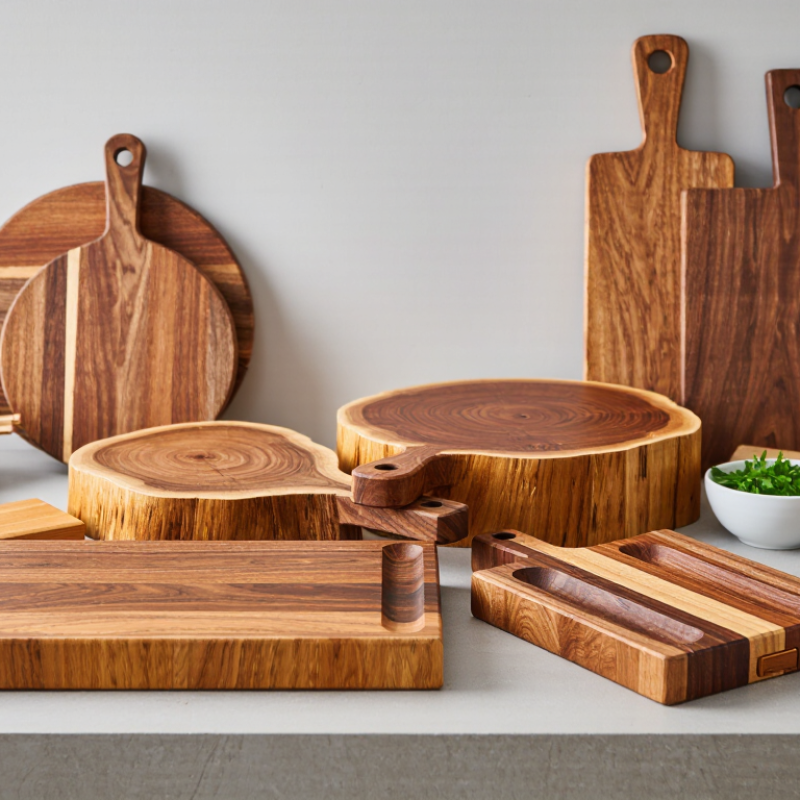
2026 Top Acacia Wood Cutting Board Types for Global Buyers

Acacia Wood Cutting Board Basics and Key Material Properties

Acacia wood cutting boards are made from a hardwood with varied color, grain, and density. Boards may range from pale honey tones to deep brown, sometimes with striking dark streaks. This variation is natural, so two boards rarely look identical. Acacia is generally durable enough for regular kitchen prep, while its surface can still show knife marks over time. That is normal wear, not proof of poor quality.

Look closely at construction, not just appearance. A well-finished board should feel smooth, sit flat, and have joints without visible gaps. Grain orientation affects how the surface responds to cutting, though workmanship and thickness matter too. Acacia’s density can make a board feel sturdy, but it may also feel heavy on a small counter. Still, no board is perfect. I would check for a stable base and practical handling before choosing a thick display-style piece.

Care helps preserve the wood. Wash the board by hand with mild soap, then dry it promptly; avoid soaking and dishwashers, which can encourage warping or cracking. When the surface looks dry or rough, apply a thin coat of food-grade mineral oil and wipe away excess. A quick test: water should bead slightly, not sit in a puddle. Natural wood needs attention. That small routine is easy to overlook.

Main Types of Acacia Wood Cutting Boards for Global Buyers

2026 Top Acacia Wood Cutting Board Types for Global Buyers

Acacia wood cutting boards suit many kitchens because the timber is dense, warm-toned, and naturally varied. Global buyers commonly choose edge-grain, end-grain, and laminated boards. Each type performs differently under daily cutting, cleaning, and shipping conditions.

Edge-grain boards use long wood strips arranged side by side. They are usually lighter and more affordable. Their smooth surface works well for vegetables, bread, and routine meal preparation.

End-grain boards place the wood fibers vertically. This structure can reduce visible knife marks and offers a sturdy surface for heavier chopping. However, end-grain models are often thicker, heavier, and more expensive to transport.

Laminated acacia boards combine several smaller pieces. They can provide practical sizes and attractive patterns, but glue-line quality deserves careful inspection.

Shape also affects the buying decision.

Rectangular boards offer dependable workspace. Round boards suit serving and compact kitchens. Boards with juice grooves help contain liquid from tomatoes or roasted meat. Handles improve carrying, although narrow handles may limit usable cutting space.

In my experience, a 35–40 centimeter board balances preparation area and storage fairly well. Still, this is not universal.

Buyers should check moisture content, flatness, food-contact finishing, edge sanding, and packaging protection.

A board may look excellent in photographs yet arrive with a slight warp. That risk is easy to underestimate.

Acacia also needs gentle washing and thorough drying; soaking can damage even a well-made board. Surface variation is normal, and small color differences should not automatically signal poor quality.

How to Compare Board Size, Grain, Thickness, and Edge Design

2026 Top Acacia Wood Cutting Board Types for Global Buyers

For global buyers, board size should match the intended kitchen task. A 30 x 20 cm board suits daily slicing and smaller worktops. Larger boards provide more space, but they require stronger packaging and storage planning. Measure the usable surface, not only the outer frame. Always confirm metric and imperial dimensions before ordering.

Grain affects appearance, stability, and perceived quality. Straight grain usually creates a cleaner visual pattern and may resist splitting better. Irregular grain looks more natural, but it can reveal uneven color or small surface changes. Inspect sample photos carefully. Thickness also matters. A 20–25 mm board feels stable for home use, while thicker boards handle heavier preparation. Thin boards are lighter and easier to ship. Edge design changes comfort and maintenance. Rounded edges feel pleasant in hand, while a juice groove helps contain liquid. Do not assume every groove has the same depth. I once treated thickness as the main quality signal. That was too simple.

Tips: Request clear photos of the top, side, and end grain. Ask for actual dimensions after sanding. Check moisture-control procedures and food-contact documentation. Compare board weight, corner finishing, and packaging protection together. A small unfinished edge can become noticeable after repeated washing. Also, natural acacia color varies, so one sample cannot represent every shipment.

2026 Top Acacia Wood Cutting Board Types for Global Buyers

How to Compare Board Size, Grain, Thickness, and Edge Design

The chart compares representative market specifications for four common acacia cutting board formats. Edge-grain boards generally provide a balanced combination of durability and price, while end-grain boards are thicker and more resistant to knife marks. Paddle-style boards are typically longer and feature a handle, whereas serving boards often use rounded edges for easier handling and presentation.

Food Safety, Care Requirements, and Expected Service Life

Acacia wood cutting boards suit global kitchens because they combine hardness, attractive grain, and practical durability. End-grain boards resist deep knife scars better, while edge-grain and laminated boards are usually lighter and more affordable. Serving boards can handle light preparation, but they should not replace a dedicated cutting surface.

Food safety depends on construction and maintenance, not appearance alone. Choose boards made from solid, well-dried acacia and finished with food-grade mineral oil or board wax. Avoid unknown coatings. Wash the surface by hand with warm water and mild soap. Dry it immediately, especially around the edges. Do not soak it or place it in a dishwasher. A damp cloth left overnight can encourage odor and surface movement.

Care is simple, but often neglected. Apply mineral oil when the grain looks pale or feels rough, usually every four to eight weeks. Use separate boards for raw meat and ready-to-eat foods where possible. Sand small knife grooves when cleaning no longer removes residue. Replace a board with deep cracks, persistent smells, or severe warping. A well-maintained acacia board may serve for five to fifteen years, depending on thickness, humidity, and daily use. Some boards last longer. Some do not. Improper drying is the common failure I would not underestimate.

Sourcing, Certification, Customization, and Global Market Considerations

Acacia wood cutting boards are gaining attention for their hardness, warm grain, and practical price. Global buyers should verify the exact species, harvest country, and plantation or forest source. The FAO Global Forest Resources Assessment 2020 reported that forests covered 31% of global land area, while 420 million hectares disappeared between 1990 and 2020. Traceability is not optional.

Ask suppliers for chain-of-custody records, legal-harvest documents, and laboratory tests for food-contact safety. FSC or PEFC certification can strengthen sourcing credibility, but certification scope must match the product and factory. The EU Deforestation Regulation also increases documentation pressure for covered commodities and related supply chains. Requirements can change. Check current rules before shipment. Small paperwork errors may delay a container.

Customization should address real kitchen use, not only appearance. Specify board thickness, edge treatment, juice grooves, handle openings, packaging moisture barriers, and engraving depth. Independent tests should examine migration, moisture content, warping, and microbial-cleaning performance. A 2023 FAO report noted that global wood production remained above four billion cubic meters annually, showing the scale of the wood sector and its environmental pressure. Buyers should compare supplier claims with test evidence. One weakness remains: acacia terminology is sometimes vague. That can create inconsistent color, density, and durability between batches. A pre-production sample and written acceptance standard are worth the extra cost.

2026 Top Acacia Wood Cutting Board Types for Global Buyers - Sourcing, Certification, Customization, and Global Market Considerations
Board Type Construction and Typical Features Common Use Sourcing Considerations Certification and Documentation Customization Options Global Market Considerations
Edge-grain laminated board Strips are joined with their long edges facing upward. Commonly made from kiln-dried acacia pieces bonded into a panel. Everyday chopping, food preparation, and general kitchen use. Check moisture content, glue-line quality, flatness, and consistency of strip color and grain. Ask how the wood was dried and stored. Request wood-species and origin information, relevant chain-of-custody documents where applicable, and food-contact material declarations for the target market. A certification should be verified for the specific supplier and product scope. Dimensions, thickness, edge profile, juice groove, hanging hole, feet, engraving, and retail packaging. A versatile format for retail and food-service channels. Confirm that board dimensions, care instructions, labeling, and packaging meet destination-market requirements.
End-grain butcher-style board Short wood blocks are arranged with their end-grain surfaces facing upward and bonded into a thicker panel. Construction is labor- and material-intensive. Heavy-duty home preparation and presentation; suitability depends on construction, finish, and care. Inspect block alignment, adhesive joints, stability, and resistance to warping. Confirm the manufacturing process can maintain repeatable thickness and flatness. Obtain material, adhesive, and finish details, plus any required food-contact declarations or test reports for the destination market. Do not assume a certificate applies to every model. Block pattern, dimensions, thickness, handles, feet, edge treatment, engraving, and protective packaging. Higher weight can affect freight cost and parcel shipping. Provide clear care guidance, including hand washing and prompt drying unless the product is specifically validated for other care methods.
Single-piece or solid-panel board Cut from one broad piece or a small number of joined pieces. A truly single-piece panel depends on available timber width and grade. Serving, light preparation, and premium-looking kitchen displays. Wide clear stock may be limited. Check for cracks, knots, grain orientation, drying history, and movement risk; request agreed grading criteria and defect tolerances. Ask for traceable sourcing records where available and product-specific documentation for finishes and food-contact suitability. Forestry claims should be supported by valid, in-scope evidence. Natural-edge options, board shape, size, handle cut-out, engraving, surface finish, and gift-box presentation. Natural variation is part of the appearance; define acceptable color and grain variation in the purchase specification to reduce disputes across shipments.
Reversible board with juice groove A flat or grooved face is paired with a second usable face. Grooves are routed near the perimeter to collect some liquids during preparation. Meat, fruit, and general food preparation where a channel can help contain juices. Check groove depth and smoothness, corner finishing, drainage, and board stability. A groove does not replace safe food handling or cleaning. Request finish and adhesive information and destination-specific food-contact documentation. Confirm that the test sample matches the production materials and construction. Groove dimensions, one- or two-sided routing, handle placement, feet, size, and custom marks. Grooves can add machining and cleaning considerations. Include use and maintenance instructions appropriate to the intended market and product design.
Serving and charcuterie board Often thinner or shaped for presentation, with a handle, hanging hole, or decorative edge. May be finished for serving as well as light cutting. Cheese, bread, appetizers, and tabletop presentation; heavy chopping is not always the intended use. Review finish uniformity, handle strength, hanging-hole position, and packaging protection. Specify whether the item is intended for food contact and cutting or primarily for serving. Keep claims about food-contact suitability aligned with product-specific evidence and local rules. Provide accurate care, material, and country-of-origin information as required. Silhouette, handle shape, engraving, gift packaging, finish, and coordinated set sizes. Gift and home-décor channels may prioritize presentation and packaging. Avoid implying a decorative finish is suitable for cutting unless validated for that use.
Nested or multi-board set Two or more boards in different sizes or shapes, sometimes sold with a stand or storage sleeve. Boards may use different constructions. Household food preparation, serving, and gift assortments. Set a specification for each board, including wood, dimensions, finish, and allowable variation. Check fit, storage design, and packaging drop protection. Documentation should cover each component and any coatings or accessories. Check labeling and packaging obligations for the complete retail set in the destination market. Board count, sizes, shapes, coordinated engraving, storage accessory, inserts, and retail box design. Sets can increase packaging volume and shipping weight. Confirm carton dimensions, retail barcode placement, and component counts before production.
Buyer checklist: Specify acacia species and declared origin where available; define dimensions, moisture and workmanship criteria, finish, adhesive, packaging, and inspection tolerances. Verify current import, labeling, chemical, and food-contact requirements with the competent authorities or qualified compliance advisers in each destination market. Certification availability and applicability depend on the supplier, product, and scope.

FAQS

What are the main types of acacia wood cutting boards?

The common types are edge-grain, end-grain, and laminated boards. Each type differs in durability, weight, appearance, and shipping cost.

What is an edge-grain cutting board best for?

Edge-grain boards use long strips arranged side by side. Their smooth surface suits vegetables, bread, and everyday meal preparation.

Why might buyers choose an end-grain board?

End-grain boards place wood fibers vertically, helping reduce visible knife marks. They suit heavier chopping but are usually thicker and more expensive to ship.

Are laminated acacia boards reliable?

Laminated boards combine several smaller wood pieces. They can offer attractive patterns and useful sizes, but inspect glue lines carefully.

Which board shape works best?

Rectangular boards provide dependable preparation space. Round boards suit serving or compact kitchens. Handles help carrying, but narrow handles reduce cutting space.

What board size suits ordinary home use?

A 30 × 20 centimeter board fits smaller worktops and daily slicing. A 35–40 centimeter board often balances workspace and storage.

How do thickness and grain affect quality?

A 20–25 millimeter board feels stable for routine home use. Straight grain may resist splitting better, while irregular grain gives a more natural appearance.

What should buyers inspect before ordering?

Request top, side, and end-grain photos. Confirm actual dimensions, flatness, moisture control, edge sanding, finishing, and packaging protection.

Does a juice groove always work equally well?

No. Groove depth varies between boards. Deeper grooves usually contain more liquid from tomatoes or roasted meat.

How should an acacia cutting board be maintained?

Wash it gently and dry it thoroughly after use. Avoid soaking. Even a well-made board can warp or suffer damage.

Can one sample represent every shipment?

Not completely. Acacia naturally varies in color and grain. I once treated thickness as the main quality signal. That was too simple.

Conclusion

In 2026, global buyers can select from a wide range of acacia wood cutting board types, including solid end-grain, edge-grain, face-grain, serving, butcher-block, and reversible designs. Acacia wood is valued for its attractive natural grain, hardness, durability, moisture resistance, and warm color variation. When comparing products, buyers should consider board length, width, thickness, grain direction, weight, handle design, juice grooves, rounded edges, and storage features according to their intended use and market preferences.

Food safety depends on responsible material selection, smooth finishing, proper sealing, and clear care instructions. Regular hand washing, prompt drying, periodic oiling, and avoiding prolonged soaking can help extend service life. For international sourcing, buyers should review supplier quality systems, material documentation, packaging, production consistency, and applicable certification requirements. Custom options may include dimensions, shapes, engraving, packaging, and private-label presentation, while shipping conditions, target-market expectations, pricing, and replacement planning should also be evaluated before placing large orders.

Charlotte

Charlotte

Charlotte is a dedicated marketing professional who combines strategic insight, industry knowledge, and a strong understanding of customer needs. As a key contributor to our company, she regularly researches market trends, follows industry developments, and creates clear, informative blog content......