
Discover expert insights, manufacturing processes, wood care guides, and industry trends from Thailand's leading OEM wooden kitchenware & furniture exporter.
The global solid wood furniture market is entering 2026 with stronger attention on durability, traceability, and responsible sourcing. Grand View Research identifies rising demand for wooden furniture, supported by premium residential projects and hospitality development. Its findings also show that consumers increasingly value natural materials and longer product life. However, market growth does not automatically prove better craftsmanship.
FAO’s Global Forest Resources Assessment 2020 recorded about 4.06 billion hectares of forest worldwide. That figure matters to every solid wood furniture manufacturer. Timber selection, legal origin, moisture control, and waste reduction now influence purchasing decisions. CSIL’s World Furniture Outlook also highlights continued international furniture trade, with Asia, Europe, and North America remaining major production and consumption regions. These reports provide useful direction, but they do not fully measure joinery quality or factory discipline.
“Furniture should be a joy forever,” said British furniture maker John Makepeace. His words remain practical, not decorative. A well-built oak table should feel stable after years of daily use. Drawers should close cleanly. A walnut surface should reveal grain, not disguise poor construction under thick lacquer. This 2026 guide examines leading manufacturers through materials, production experience, certifications, design consistency, and export capability. It also considers uncomfortable details, including supply-chain opacity and exaggerated sustainability claims. No ranking is perfect. A large factory may offer reliable volume, while a smaller workshop may deliver deeper craftsmanship. Buyers should compare evidence, not polished photographs.
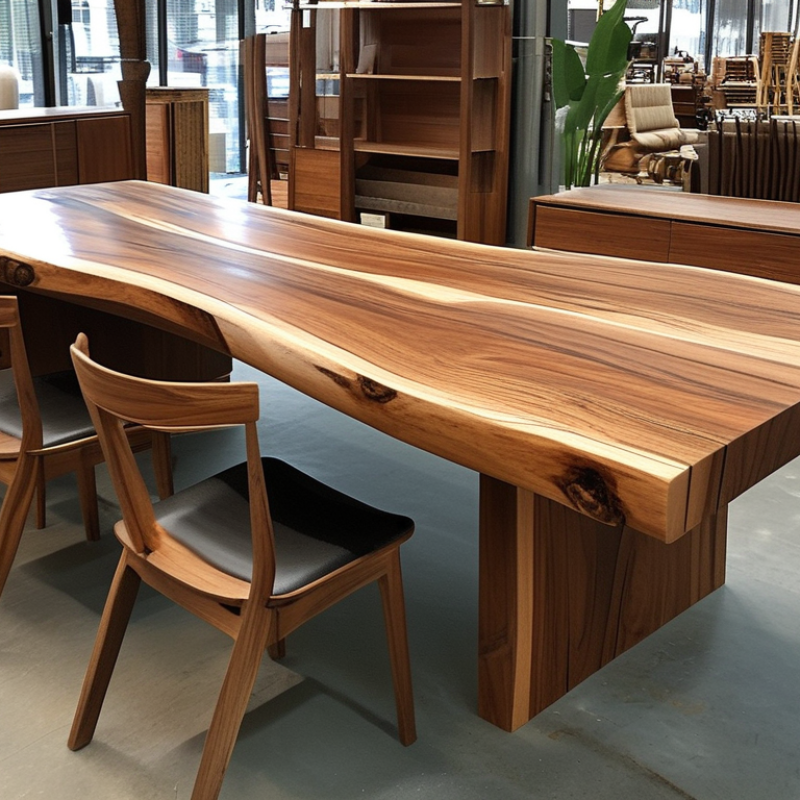
Solid wood furniture is made mainly from natural lumber, not veneer-covered fiberboard or particleboard. Its scope includes timber selection, kiln drying, grading, machining, joinery, sanding, finishing, and quality inspection. Tables, bed frames, cabinets, and chairs may qualify when their structural parts use solid wood. Edge-glued panels can also qualify, although the boundary is not perfectly clean.
The Food and Agriculture Organization’s Global Forest Resources Assessment 2020 reports 4.06 billion hectares of forest worldwide. FAOSTAT data recorded approximately 3.9 billion cubic meters of global roundwood production in 2022. These figures show the scale of the resource base, but they do not measure solid furniture directly. That gap matters. Industry comparisons should separate solid lumber from veneer, MDF, and recycled composite materials. A “solid wood” product may still contain composite drawer bottoms, metal hardware, or adhesive joints.
Tips: Check the material specification, not only the product title. Ask for the wood species, moisture content, panel construction, and responsible sourcing evidence. Kiln-dried lumber usually performs better indoors, but poor joinery can still cause movement or cracking. Certification helps, though it is not a substitute for factory audits and clear documentation. Manufacturers should report these details consistently. Many still do not.
Evaluating top solid wood furniture manufacturers in 2026 requires more than inspecting polished photographs. Start with timber traceability. The FAO Global Forest Resources Assessment 2020 reported that forests cover about 31% of global land, while 420 million hectares disappeared between 1990 and 2020. A credible manufacturer should identify wood species, harvest regions, and chain-of-custody controls. Vague sourcing claims deserve scrutiny.
Material performance needs measurable proof. Ask for moisture content records, usually near 6% to 10% for interior furniture, depending on climate and construction. Check kiln-drying methods, joint design, coating durability, and independent testing. The ISO Survey of Management System Standards shows the widespread use of certified quality and environmental systems, but certification alone cannot prove excellent craftsmanship. Factory visits still matter. Look closely at drawer movement, end-grain cracks, sanding marks, and uneven finishes.
Environmental evaluation should include energy use, waste handling, packaging, and repairability. The UNEP Global Status Report for Buildings and Construction 2022 states that buildings and construction generated 37% of global energy-related and process CO2 emissions in 2021. Furniture is only one part of this impact, yet manufacturers should disclose relevant data rather than use broad green language. Worker training, accident records, delivery consistency, and after-sales support also reveal operational maturity. My assessment would remain cautious when reports are incomplete. Even strong factories can miss targets during rapid expansion.
This evaluation framework uses weighted, verifiable criteria for comparing solid wood furniture manufacturers worldwide. The benchmarks are intended for 2026 supplier assessment and should be verified against the applicable destination-market requirements and product category.
| Evaluation Criterion | Weight | Recommended 2026 Benchmark | Evidence to Verify | Evaluation Purpose |
|---|---|---|---|---|
| Wood Origin and Chain of Custody | 20% | Active FSC or PEFC chain-of-custody certification for applicable products, with documented species origin and traceable supplier records. | Valid certificate, certificate scope, transaction documentation, species declarations, legality-risk assessment, and supplier audit records. | Measures responsible sourcing, legal traceability, and the credibility of sustainability claims. |
| Material Authenticity and Product Transparency | 15% | Clear disclosure of solid wood species, wood-based panels, veneers, laminates, adhesives, metal parts, and recycled content for every product range. | Technical specifications, bills of materials, product drawings, material declarations, and production-stage inspections. | Distinguishes genuinely solid wood construction from products marketed primarily through appearance or wood-effect finishes. |
| Moisture Control and Dimensional Stability | 15% | Kiln-drying records and documented moisture-control procedures. A typical interior-furniture target in many temperate settings is approximately 6–8% moisture content, adjusted for destination climate. | Kiln schedules, moisture-meter calibration records, incoming and final inspection reports, acclimatization procedures, and climate-specific specifications. | Reduces risks of warping, cracking, joint failure, shrinkage, and swelling after delivery. |
| Structural Safety and Durability Testing | 12% | Product-category testing against applicable standards, such as EN 12520 for domestic seating, EN 16139 for non-domestic seating, or EN 14749 for storage furniture. | Independent laboratory reports, test samples, load ratings, cycle-test results, corrective-action records, and product-specific declarations. | Assesses safety, load-bearing performance, fatigue resistance, and suitability for intended use. |
| Finish Quality and Chemical Compliance | 10% | Documented finish system with controlled application parameters and testing for resistance to liquids, wet heat, dry heat, abrasion, and adhesion where relevant. | Finish technical data sheets, safety data sheets, batch records, quality-control results, and applicable tests such as EN 12720, EN 12721, EN 12722, or equivalent methods. | Evaluates surface longevity, appearance retention, maintenance requirements, and chemical-risk management. |
| Formaldehyde and Indoor-Air Compliance | 10% | For wood-based panels used in furniture, demonstrate compliance with the destination-market requirement. Under EN 717-1, the E1 emission class is associated with a limit of 0.124 mg/m³ in the chamber test. | Current laboratory emission reports, panel supplier declarations, adhesive specifications, and compliance documentation for the intended market. | Controls emissions from panels, adhesives, and composite components; solid wood does not eliminate the need to assess added materials and finishes. |
| Quality Management and Process Control | 8% | A documented quality-management system, preferably certified to ISO 9001 or supported by equivalent controls covering design, purchasing, production, inspection, and corrective action. | Certification status, process maps, inspection plans, nonconformance records, calibration logs, internal-audit results, and traceability procedures. | Measures consistency, repeatability, defect prevention, and the manufacturer’s ability to maintain quality at scale. |
| Environmental and Worker-Health Management | 5% | Formal controls for energy, waste, water, finishing emissions, occupational safety, and chemical handling; ISO 14001 and ISO 45001 certification are strong supporting evidence. | Environmental and safety certificates, waste records, energy data, chemical inventories, ventilation inspections, incident statistics, and worker-training records. | Assesses operational responsibility and the resilience of manufacturing practices. |
| After-Sales Support and Warranty Capability | 5% | Written warranty terms, documented spare-parts availability, repair procedures, complaint response targets, and product-care instructions in the buyer’s market. | Warranty policy, service-level procedures, replacement-part lists, claim statistics, repair records, and customer-support documentation. | Indicates long-term accountability, maintainability, and the total ownership value of the furniture. |
Europe remains a strong region for solid wood furniture manufacturing in 2026. Producers in Italy, Germany, Poland, and Scandinavia often emphasize precise joinery, low-emission finishes, and long product lifecycles. Oak, beech, ash, and walnut are common choices. Experienced workshops usually document timber origin, moisture content, kiln-drying schedules, and surface treatments. These details matter when furniture moves between humid and dry climates.
North America combines advanced production with practical design. Manufacturers in the United States and Canada commonly work with maple, oak, cherry, and walnut. Many facilities use computer-controlled cutting for consistency, then rely on hand sanding for visible surfaces. That combination can reduce waste, but it does not guarantee flawless results. Small color variations are normal in natural timber.
Asia offers broad manufacturing capacity, from highly automated plants to family-run workshops. Vietnam, China, Indonesia, and Malaysia are notable production centers, each with different material strengths and finishing traditions. Buyers should examine forest-management documentation, factory inspection records, and sample construction before selecting a supplier. Regional labels can mislead. A factory’s actual experience with moisture control, hardware installation, and export packaging is more useful than its location alone. Latin American producers add distinctive species and handcrafted techniques, especially with tropical hardwoods. However, responsible sourcing requires careful verification, not attractive photographs.
The 2026 solid wood furniture market rewards manufacturers that control material quality from forest to workshop.
FAOSTAT recorded global roundwood production at about 3.9 billion cubic metres in 2022. That scale makes traceability essential, especially for oak, walnut, ash, and tropical hardwoods. Reliable factories document species, origin, moisture content, and grading before production begins.
Craftsmanship remains visible in small details.
Kiln-dried boards typically require moisture control near 8–12% for interior furniture, depending on the destination climate. Skilled makers inspect grain direction, repair minor defects, and use mortise-and-tenon or dowel joints where movement matters.
CNC machining improves repeatability, but it cannot replace a craftsperson’s judgment around knots, sapwood, or uneven colour. The UNECE/FAO Forest Products Annual Market Review shows how strongly sawnwood demand and supply respond to construction cycles. Furniture producers therefore need flexible cutting plans, not only large machinery.
Production capability also means disciplined finishing and testing.
A serious facility should measure coating thickness, adhesion, edge durability, and dimensional stability. Chain-of-custody systems add useful evidence; certification reports from major forestry organizations show extensive global adoption across timber supply networks.
Still, paperwork is not proof of perfect practice. A factory may pass an audit yet waste valuable offcuts or struggle with inconsistent drying. That weakness deserves attention.
The strongest manufacturers combine transparent sourcing, experienced joiners, modern equipment, and measurable quality checks across every production stage.
In 2026, top solid wood furniture manufacturers will compete on traceability, not appearance alone. The FAO Global Forest Resources Assessment 2020 records 4.06 billion hectares of global forest. However, 420 million hectares disappeared between 1990 and 2020. Responsible manufacturers should document forest origin, species, harvesting permits, and transport records. Chain-of-custody certification from recognized systems can support this evidence, but certification is not magic. Audits may miss weak supplier practices.
Market pressure is also changing. The European Union Deforestation Regulation requires companies to prove that covered commodities are deforestation-free and legally produced. This raises compliance expectations for exporters serving European buyers. Digital timber passports, geolocation data, and batch-level records will become practical selection criteria. The Ellen MacArthur Foundation estimates that less than 10% of the global economy is circular, showing how much furniture production still depends on linear extraction and disposal.
Energy use deserves equal attention. The International Energy Agency reports that industry remains a major source of global carbon emissions, while wood processing adds drying, cutting, coating, and packaging impacts. Manufacturers should publish product carbon data, repair policies, recycled packaging rates, and expected service life. Real workshop evidence matters: moisture-controlled timber, low-emission finishes, and replaceable joints are visible details. Still, some sustainability claims remain incomplete. A durable table may use responsibly sourced wood but excessive packaging. Buyers should question both strengths and gaps.
The chart compares regional forest resources that form the raw-material base for sustainable solid-wood furniture production. Europe had the largest forest area in 2020, followed by South America and North and Central America. Responsible manufacturers should connect sourcing policies with recognized systems such as FSC or PEFC chain-of-custody certification, legal-harvest requirements, and applicable regulations including the EU Deforestation Regulation. Data source: FAO, Global Forest Resources Assessment 2020. The figures describe regional forest area and do not rank individual companies or brands.
Ask for the wood species, harvest region, and chain-of-custody records. Vague sourcing claims need scrutiny. A timber passport or batch record adds useful detail.
Indoor furniture often needs moisture content near 6% to 10%. The correct range depends on climate and construction. Ask for kiln-drying records. Numbers alone do not guarantee stability.
Inspect drawer movement, joint strength, end-grain cracks, and sanding marks. Uneven finishes can expose rushed work. Factory visits remain valuable. Photographs can hide defects.
Europe often emphasizes precise joinery and long product lifecycles. North America commonly uses maple, oak, cherry, and walnut. Several Asian regions offer large-scale factories and family workshops. Latin America adds distinctive species and handcrafted methods.
No. A factory’s actual experience matters more than its location. Check moisture control, hardware installation, export packaging, and sample construction. Regional labels can mislead. I would compare evidence, not assumptions.
Look for timber origins, harvesting documents, energy use, waste handling, and packaging data. Repair policies and expected service life also matter. Low-emission finishes can reduce indoor pollution. Green language alone proves little.
No certification is perfect. Audits may miss weak supplier practices. Review factory records, supplier controls, and physical products together. A certified factory can still miss targets during rapid expansion.
Request independent testing for joints, coatings, and surface wear. Check whether damaged parts can be replaced. Look for solid connections instead of hidden shortcuts. Small color changes are normal in natural timber.
Ask how the furniture is protected during export and how much packaging is used. Strong packaging prevents damage, but excessive materials increase environmental impact. Delivery consistency and after-sales support reveal operational maturity. Even good factories make occasional mistakes.
This article presents a comprehensive overview of the global solid wood furniture industry in 2026, beginning with the definition and scope of solid wood furniture manufacturing. It explains how leading companies are evaluated through factors such as material quality, design capability, production efficiency, craftsmanship, customization, international service, and quality control. The discussion also compares major manufacturers across different regions, highlighting variations in production strengths, design traditions, supply chain resources, and market positioning.
In addition, the article examines the materials, technologies, and skilled processes that shape high-quality solid wood furniture, from responsible timber selection and precision processing to finishing and durability testing. Sustainability is another central theme, including traceable sourcing, efficient resource use, responsible manufacturing, and compliance with evolving environmental expectations. By reviewing global market trends in 2026, the article helps readers understand how a reliable solid wood furniture manufacturer can balance craftsmanship, innovation, sustainability, and competitive production capabilities in an increasingly international marketplace.